Brow Lift in Bellevue
A brow lift repositions a descended brow and opens the upper face. Done well, people ask whether you have been on vacation, never whether you have had surgery.
The comparison with wrinkle-relaxer injections is honest and quantified: a neuromodulator brow lift raises the brow one to three millimeters for three to four months; surgery raises it five to ten millimeters or more, lastingly.
Dr. Day selects from five approaches by your hairline, forehead height, and the correction you need.



Your surgeon
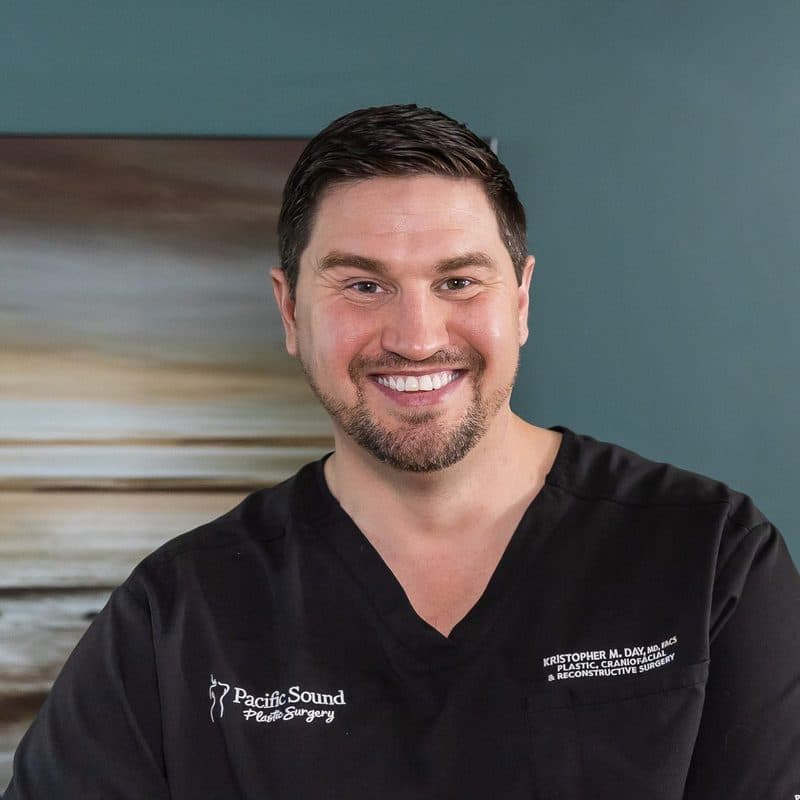
Dr. Kristopher Day is certified by the American Board of Plastic Surgery and the American Board of Surgery, fellowship-trained in craniofacial surgery, and a member of the American Society of Maxillofacial Surgeons.
Meet Dr. DayThe operation
Every consultation — and every operation — is with Dr. Day.
The forehead is more crowded than it looks. The frontalis muscle raises the brow. The corrugator and procerus muscles pull it down and inward, and they are what carve the vertical elevens. The supraorbital and supratrochlear nerves carry sensation across the forehead, and the temporal branch of the facial nerve, which moves the brow, runs through the same territory. A brow lift is planned around those structures, which is why it is anatomy work rather than skin tightening.
Whatever the approach, the principle holds: the brow and forehead tissues are released from the bone, repositioned to the height your anatomy actually supports, and secured there. Skin is not simply pulled upward. The endoscopic approach does this through three to five one-centimeter incisions inside the hairline, with a camera for visualization.
The frown muscles can be selectively weakened through that same access, softening the vertical elevens at their source rather than masking them. Injectables relax those muscles for a few months at a time; surgery reaches them directly.
Surgery runs about ninety minutes to two hours under general anesthesia or IV sedation, at an accredited surgery center — Carillon Point Surgery Center or Sound Plastic Surgery Center. Most patients go home the same day.
Five approaches
The approaches differ in where the incision sits and how much correction they can deliver. Your hairline position, forehead height, and the amount of lift you need decide which one is honest for you.
Endoscopic
Three to five one-centimeter incisions behind the hairline, with a camera guiding the lift. Least dissection and the quickest recovery, and the workhorse for most patients.
Temporal (lateral)
Targets the outer third of the brow, where descent often shows first. Frequently combined with a facelift.
Pretrichial
The incision runs just in front of the hairline rather than behind it, so a full lift is possible without pushing the hairline back. The right answer for a high forehead, which a coronal lift would only make taller.
Coronal (open)
An incision across the top of the scalp, giving the most correction where brow descent is significant.
Direct
An incision immediately above the brow, reserved for select cases — most often correcting a marked asymmetry where the lift has to be measured differently on each side.
Is it right for you
If the heaviness you feel sits above the eyes rather than in the lids, the brow is the true source, and lifting it treats both the position and the tired read. The exam distinguishes brow from eyelid honestly, and the two operations frequently pair. Treating one and ignoring the other is the usual reason a result feels incomplete.
There is a second distinction worth making before anything is scheduled: whether what bothers you is soft tissue that has descended or bone that has always projected. A brow lift repositions tissue. It does not reduce a heavy brow ridge. If the ridge itself is the issue, that is a different operation, described below.
Brow asymmetry is common, and it has causes — native anatomy, old trauma, differences in facial nerve function. Elevation can be set independently on each side, so asymmetry is something to raise at consultation rather than something to accept.
Smoking stops four to six weeks before and after surgery. Aspirin, ibuprofen, fish oil, vitamin E, and herbal supplements pause beforehand, and you will get a specific written list at scheduling rather than a general warning.
Recovery
Expect forehead and brow swelling with bruising around the eyes in the first days. It starts resolving within seven to ten days, helped along by head elevation and cold compresses on the schedule the team gives you.
By the end of week two most bruising has faded and the brows begin settling into position. Numbness or tingling across the forehead and scalp is normal at this stage and is not a sign that something went wrong: the sensory nerves are recovering, and that takes months rather than weeks.
Desk work resumes in the first week. Exercise builds from week two at half effort, increasing gradually, with full unrestricted activity at four to six weeks.
The settled position reads clearly at about three months, once swelling has fully resolved. The repositioned brow is lasting. You continue to age from that starting point, and sun protection does more for the longevity of the result than anything else within your control.
How the weeks before and after surgery fit together is covered in the practice's recovery guide.
Plan a consultation with Dr. Day.
Brow bone reduction is a different operation
A lift moves soft tissue. Reducing a projecting brow ridge means reshaping bone.
Some upper faces read heavy because of the supraorbital rim, the bony ridge above the eye sockets. A prominent ridge casts a shadow over the eyes and reads as hard or tired regardless of where the brow sits. No amount of lifting changes it, because the projection is bone. Reducing it is called brow bone reduction, or frontal cranioplasty.
Planning starts with a CT scan of the skull, because the frontal sinus sits directly behind the bone being reshaped and its size determines what is safely possible. Where the bone is thick and the sinus small, the ridge can be reduced by contouring the bone directly. Where the sinus is large and close to the surface, the anterior wall has to be removed, reshaped, and secured back in its new position — a considerably more involved operation, and the reason the imaging comes first. For complex cases Dr. Day plans the contour in advance using three-dimensional virtual surgical planning.
The incision is the same territory as a brow lift: pretrichial, just in front of the hairline, when the hairline is being advanced at the same time, or coronal, within the hair-bearing scalp, when it is not. The two operations are often done together for that reason, under one anesthetic and one recovery.
Brow bone reduction is craniofacial bone surgery rather than soft-tissue work, and Dr. Day's fellowship in craniofacial and pediatric plastic surgery is training in exactly these structures. Done for appearance, it is a self-pay procedure; done to reconstruct after trauma, tumor removal, or a congenital difference, insurance may cover part or all of it. Pricing is quoted in writing at consultation, since it depends on which technique your anatomy calls for and whether a brow lift is part of the same plan.
Patient Voices
Individual results vary. Quotes are verbatim excerpts from reviews published by patients.
“He takes the time to understand your aspirations, vision, and goals, ensuring that your desired outcomes are at the forefront of his care.”
“Dr. Day's knowledge, compassion, and attention to detail made all the difference in my recovery process.”
“He took the time to listen to my concerns and desires, ensuring I had a clear understanding of the procedure, expected outcome and healing process. … I think he's a very skilled and precise surgeon.”
Questions, answered
The rest belong in a conversation. Consultations are unhurried by design.
Brow lift or wrinkle relaxer?
A neuromodulator raises the brow one to three millimeters and lasts three to four months; surgery raises it five to ten millimeters or more and lasts. If you like your injectable result but wish it were stronger and did not need repeating, that is the surgical conversation.
Will I look surprised?
A modern brow lift repositions to where your brow used to sit, not above it. The startled look comes from over-elevation, and restraint is the design principle here.
Can it be combined with eyelid surgery?
Frequently — the two treat different components of the same tired look, and combining them in one session is routine.
Where are the incisions?
For the endoscopic approach, three to five small incisions hidden in the hairline. The pretrichial approach runs along the hairline's edge and preserves forehead height for patients who need that.
What happens to my frown lines?
The muscles that create the vertical elevens can be selectively weakened during the lift, softening those lines at the source rather than masking them.
What is the difference between a brow lift and brow bone reduction?
A brow lift repositions soft tissue. Brow bone reduction reshapes the bony ridge above the eye sockets. If your upper face reads heavy because the ridge projects, lifting will not change it, and the exam sorts out which one you are. They are frequently done together.
Can a brow lift correct asymmetrical brows?
Often, yes. Elevation is set independently on each side, so an asymmetry from native anatomy, old trauma, or a difference in nerve function can be evened out. Perfect symmetry is not the promise; meaningful improvement usually is.
Will my forehead be numb afterward?
Numbness or tingling across the forehead and scalp is normal in the weeks after surgery and is part of the sensory nerves recovering. It resolves gradually, over months rather than weeks.
How long do the results last?
The repositioned brow is lasting. Aging continues from that new starting point, and patients consistently find the upper face reads more rested than it would have otherwise. Sun protection and general skin care do the compounding.
What do I need to stop before surgery?
Smoking stops four to six weeks before and after. Aspirin, ibuprofen, fish oil, vitamin E, and herbal supplements pause beforehand, along with certain other medications depending on your history. You get a specific written list when you schedule.
How much does a brow lift cost in Bellevue?
Brow lifts start from $7,500, with the total shaped by approach and combined procedures. Your consultation includes a written breakdown, with CareCredit and Alphaeon financing available.
Financing Options