Liposuction for Men in Bellevue
Male fat is different tissue. It is denser and more fibrous than female fat, it concentrates in the flanks, abdomen, and chest, and it holds on through training that works everywhere else. Liposuction for men is planned around those differences from the start.
The goal is rarely smallness. Men ask for definition: a flatter abdomen, a cleaner waistline, a chest without fullness, and a result that looks like the training finally showed up.
Dr. Day selects the technique for fibrous male tissue at consultation, with high-definition contouring where your anatomy supports it.




Your surgeon
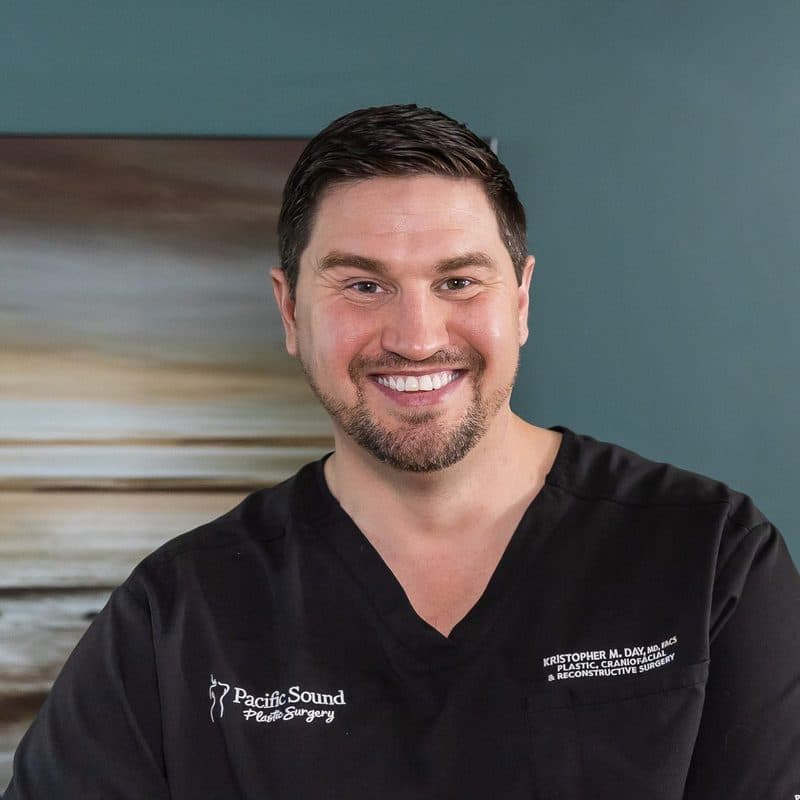
Dr. Kristopher Day is certified by the American Board of Plastic Surgery and the American Board of Surgery, fellowship-trained in craniofacial surgery, and a member of the American Society of Maxillofacial Surgeons.
Meet Dr. DayThe operation
Every consultation — and every operation — is with Dr. Day.
Every case starts with tumescent fluid, which numbs the area and constricts vessels before any fat moves. That step is what keeps intraoperative bleeding and bruising down and what makes precise sculpting possible. From there the male plan diverges: fibrous tissue often calls for ultrasound assistance to loosen fat before removal, and both cannula technique and the pressure used adjust to denser tissue rather than forcing through it.
Access is through poke holes of roughly two to three millimetres, placed in natural skin folds or otherwise discreet locations, which typically heal to marks most patients stop noticing.
The male torso is treated as one shape. Flanks, lower abdomen, and back read together from every angle, and circumferential contouring keeps the waistline continuous instead of spot-treated.
Chest fullness gets a diagnosis before a plan: fatty fullness — pseudogynecomastia — responds to liposuction alone, while a firm, disc-like layer beneath the nipple is true glandular gynecomastia and needs excision, a different operation this practice also performs. The exam tells us which you have, and sometimes the answer is both.
Surgery is performed under general anesthesia or deep sedation at one of Dr. Day's accredited surgical facilities — Swedish Medical Center, Virginia Mason Franciscan Health, or Carillon Point Surgery Center.
The consultation is conducted by Dr. Day personally, not by a coordinator presenting a pre-built package, and there is no expectation that you decide that day. Beforehand you will pause specific medications and supplements that affect bleeding and healing — aspirin, ibuprofen, vitamin E, fish oil among them — from a list the office provides. Nicotine stops at least four weeks before and stays stopped four weeks after.
Where men carry it
The male pattern has its own map. These are the areas men actually book.
Flanks
The love handles: the most requested male area, treated as part of one continuous waistline.
Abdomen
The pinchable layer above the muscle wall. What sits behind the wall is a different problem, answered honestly below.
Chest
Fatty fullness contoured by liposuction; glandular tissue routed to gynecomastia surgery instead.
Neck & jawline
The submental pocket that blurs a jawline, treatable under local anesthesia in select cases.
Is it right for you
Liposuction removes subcutaneous fat, the layer you can pinch. A firm, round abdomen that feels tight rather than soft is usually visceral fat behind the muscle wall, and no cannula reaches it: that weight comes off with diet, exercise, or medical weight management first. You will hear that answer plainly at the exam.
Good candidates are near a stable weight with localized deposits and reasonable skin elasticity. Typical removal runs from about two to six pounds; the change you see is contour, never scale.
The second honest limit is skin. Liposuction removes volume and does nothing to tighten the envelope over it. Whether skin redrapes smoothly depends on how much fat comes out, how much excess was there to begin with, your own elastic recoil, and how faithfully you wear the garment. Where laxity is already the larger problem, an excisional operation is the honest recommendation and liposuction becomes the supporting tool.
High-definition contouring — sharpening the transitions between muscle groups rather than only reducing volume — rewards good skin quality and a stable weight. It is an anatomy conversation, not a request form, and the answer is sometimes no.
Recovery
A compression garment follows the 23-and-3 rule: around the clock for at least three weeks, removed only to shower and wash it, and encouraged to three months for the best final contour. Walking starts the day after surgery, and desk work resumes within a few days to a week.
Training builds back on a deliberate ramp rather than a switch. Exertional activity restarts at week two at roughly half your pre-operative maximum, increasing by about five percent a day, with full gym intensity typically back by weeks four to six.
Bruising fades over two to three weeks. Lymphatic massage is often recommended to help swelling resolve. The final contour reads at three to six months once residual swelling is gone — which is why judging the result at week three is judging swelling.
How the weeks before and after surgery fit together is covered in the practice's recovery guide.
Plan a consultation with Dr. Day.
Patient Voices
Individual results vary. Quotes are verbatim excerpts from reviews published by patients.
“Dr. Day was so compassionately patient and really took the time. … After the surgery, Dr. Day was just as dedicated and regularly checked up with me throughout my healing process.”
“Dr. Day and his team provided expert individualized care from the initial consultation through post-op check ups.”
“He takes the time to understand your aspirations, vision, and goals, ensuring that your desired outcomes are at the forefront of his care.”
Questions, answered
The rest belong in a conversation. Consultations are unhurried by design.
How is liposuction for men different?
Male subcutaneous fat tends to be denser and more fibrous than female fat, which changes cannula technique and the pressures used. The target differs too: men generally want a flatter abdomen and a defined waistline rather than curvature. The male pattern of flanks, abdomen, and chest shapes the plan from the first mark.
Can liposuction fix a beer belly?
It depends on where the fat sits. Soft, pinchable fullness above the muscle wall responds to liposuction. A firm belly pushed forward from behind the wall is visceral fat, which no liposuction can reach; that calls for weight loss first, and the exam distinguishes the two in minutes.
Will I have loose skin afterward?
Possibly, and it is worth asking before rather than after. It depends on the volume removed, how much skin excess you already had, your skin's elastic recoil, and garment compliance. Energy-based techniques such as VASER and Renuvion stimulate some skin retraction alongside fat removal, which is one reason they get selected. Dr. Day assesses your skin quality at consultation and will tell you if excision is the more honest answer.
How much does male liposuction cost?
Liposuction at Pacific Sound Plastic Surgery starts from $3,000 per area, shaped by the number of areas and operative time. Your consultation includes a written breakdown, with CareCredit and Alphaeon financing available.
Financing OptionsWhat about chest fat?
The exam decides. Soft fatty fullness — pseudogynecomastia — is treated with liposuction alone through a few millimetre access points. A firm, disc-like layer beneath the nipple is true glandular gynecomastia, which needs excision, sometimes combined with liposuction. This practice performs both, so the answer you get is not shaped by what is on offer.
What is high-definition liposuction?
Selective contouring that sharpens the transitions between muscle groups rather than just reducing volume. It rewards good skin elasticity and stable weight, and candidacy is an anatomy conversation, not a request form.
Can I be awake for it?
For select smaller areas, yes — under tumescent local anesthesia alone, with no general anesthetic and a faster same-day recovery. The honest caveat is that being awake for liposuction is uncomfortable and you have to be able to tolerate it. Most patients choose general anesthesia or deep sedation, and that is a reasonable choice rather than a lesser one.
Where is the surgery performed?
At Dr. Day's accredited surgical facilities: Swedish Medical Center, Virginia Mason Franciscan Health, or Carillon Point Surgery Center, matched to the scope of your case.
When can I get back to the gym?
Walking immediately and desk work within a few days to a week. Training restarts at week two at about half your previous maximum and increases by roughly five percent a day, reaching full intensity around weeks four to six. The compression garment does quiet work in the background the whole time.