Gender-Affirming Body Contouring in Seattle & Bellevue
Hormone therapy redistributes fat, but it cannot change the skeleton underneath — and for many patients the shape that still reads wrong is the trunk. Body contouring works on the layer hormones cannot reach: it moves soft tissue, taking volume from where it reads against you and placing it where it reads for you.
The tools are liposuction and fat grafting, almost always in the same operation. Fat removed from one area is processed and placed into another, which is why the procedure is sometimes described as reverse liposuction.
The direction is yours to set. Feminizing plans generally define a waist-to-hip ratio; masculinizing plans generally broaden and square the trunk. Nothing here assumes which one you want.





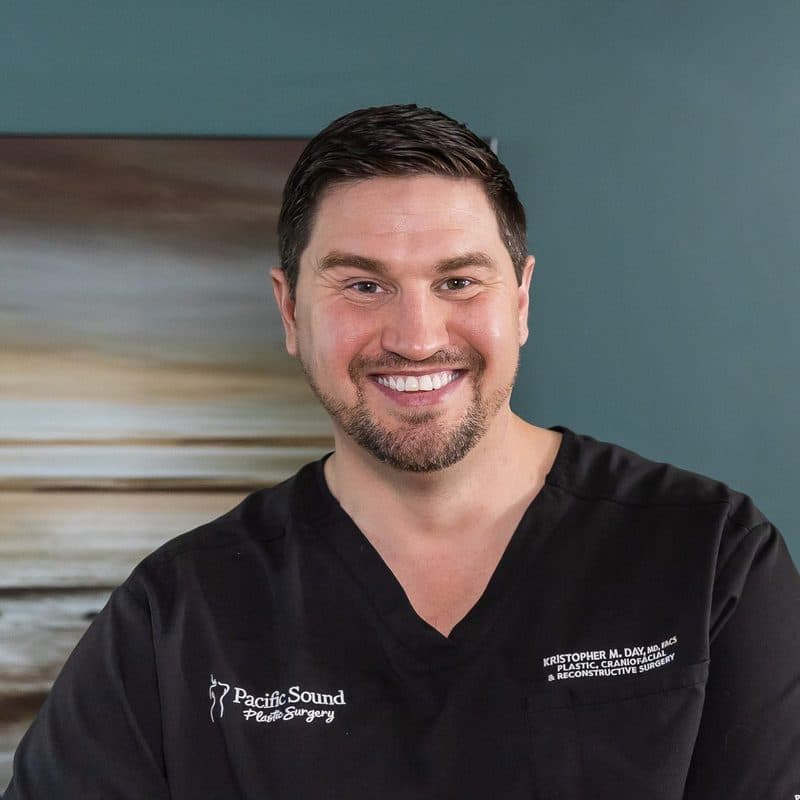
Your surgeon
Dr. Kristopher Day is certified by the American Board of Plastic Surgery and the American Board of Surgery, fellowship-trained in craniofacial surgery, and a member of the American Society of Maxillofacial Surgeons.
Meet Dr. DayThe operation
Every consultation — and every operation — is with Dr. Day.
Liposuction comes first, harvesting fat from the areas being reduced — and that reduction is half the result, not merely a means of collecting material. The fat is then purified and placed in small, controlled passes into the areas being built.
Where fat is grafted to the buttocks, ultrasound guidance confirms placement in the subcutaneous layer above the muscle, following the ASPS Gluteal Fat Grafting Safety Advisory. That is the same protocol used for every fat transfer in this practice.
Roughly forty to fifty percent of grafted fat establishes permanent blood supply, so measured extra volume is placed to offset the expected absorption. What survives at three to six months is stable, behaves like the tissue around it, and does not need maintenance. Some patients choose a second grafting session later if they want more volume in a particular area.
Two directions
Same two tools, opposite geometry. The plan is drawn on your body at consultation rather than chosen from a template.
Feminizing
Liposuction narrows the waist, trunk, and flanks; fat grafting adds volume to the hips and buttocks. The goal is a defined waist-to-hip ratio, built from the proportions you already have.
Masculinizing
Liposuction reduces fullness at the hips and thighs; fat grafting builds the lateral flanks. The goal is a broader, more rectangular trunk that reads square rather than curved.
Is it right for you
Good candidates are in reasonable health, at a stable weight, and clear-eyed about what soft-tissue surgery does. It changes contour, not frame: the pelvis and shoulders are bone, and no amount of contouring alters them. Where your goals depend on skeletal proportion rather than soft tissue, you will hear that plainly instead of after an operation that could not deliver it.
Enough donor fat has to exist to harvest. Very lean patients sometimes do not have the raw material for the grafting half of the plan, and that answer comes at consultation rather than in the operating room.
Insurance coverage varies by plan. Where it may apply, carriers generally want a support letter per the WPATH Standards of Care — most patients obtain it from their therapist or primary-care provider, and securing it is yours. Pre-authorization typically runs four to six weeks and can only begin after the surgical consultation.
Recovery
Both the donor and recipient areas swell and bruise, and the first week's mirror is not the result — that is worth knowing before you look. A compression garment is worn around the clock for at least three weeks, and up to three months for the best contour.
Most patients are back to desk work within three to five days and to ordinary activity by about week two. Where fat has been grafted to the buttocks, no direct sitting for two to three weeks, using a support pillow when sitting is unavoidable.
By weeks three to six most swelling has resolved and the shape starts telling the truth. The final contour arrives between three and six months, once residual swelling clears and the surviving fat has stabilized. Liposuctioned fat cells do not return, so the result holds as long as your weight does.
How the weeks before and after surgery fit together is covered in the practice's recovery guide.
Plan a consultation with Dr. Day.
Patient Voices
Individual results vary. Quotes are verbatim excerpts from reviews published by patients.
“He took the time to listen to my concerns and desires, ensuring I had a clear understanding of the procedure, expected outcome and healing process. … I think he's a very skilled and precise surgeon.”
“I have always gotten the realistic results I hope for.”
“Dr. Day was so compassionately patient and really took the time. … After the surgery, Dr. Day was just as dedicated and regularly checked up with me throughout my healing process.”
Questions, answered
The rest belong in a conversation. Consultations are unhurried by design.
What is the difference between liposuction and fat grafting?
Liposuction removes fat from where it is unwanted — waist, flanks, hips, thighs. Fat grafting places that same fat where more volume is wanted. In this procedure they are two halves of one operation: what comes out of one area goes into another, in a single surgery.
What does “reverse liposuction” mean?
It is another name for fat grafting. Standard liposuction takes fat out; grafting puts it in. The fat is entirely your own, harvested during the same operation, processed, and injected in small precise increments.
How is feminizing different from masculinizing contouring?
The geometry. Feminizing plans narrow the waist and add volume to the hips and buttocks, defining a waist-to-hip ratio. Masculinizing plans reduce the hips and thighs and build the lateral flanks for a squarer trunk. The techniques are the same; where they are applied is the opposite.
How much of the grafted fat survives?
Roughly forty to fifty percent establishes permanent blood supply over the first three to six months; the rest is absorbed, which is expected and planned for. What survives is durable and behaves like the surrounding tissue.
Will it look natural?
The volume is your own tissue rather than an implant, so it moves and feels like the rest of you. The change also arrives gradually as swelling resolves over months rather than appearing overnight, which is part of why it reads as natural.
Can contouring change my hips or shoulders?
Not their bone structure. Contouring reshapes the soft tissue over the skeleton, which is often enough to change how a silhouette reads — but the frame itself does not move. That distinction gets drawn honestly at consultation, because it decides whether this operation can do what you want.
Can it be combined with other procedures?
Frequently, and combining liposuction with grafting is already the standard here. Some masculinizing plans include abdominal contouring; some patients pair contouring with chest surgery. What is safe to combine depends on your anatomy and total operating time, and you will get a straight answer.
Is it covered by insurance?
It varies by plan, and coverage is less common for contouring than for chest surgery. Where it may apply, the WPATH support letter is the usual requirement and pre-authorization runs four to six weeks. You will get an honest read on your specific plan before the paperwork starts.