Pectoral Augmentation in Bellevue
Pectoral augmentation places solid silicone implants beneath the chest muscle: definition for chests that training cannot build, and reconstruction for chests that asymmetry or Poland syndrome shaped differently.
Training builds and shapes the muscle you have. How large that muscle can become, and where it attaches, is largely genetic — which is why some men reach a ceiling on the chest while everything else responds. An implant adds structure underneath rather than asking the muscle to do more.
It is an uncommon operation in any practice, and this page treats that honestly. Dr. Day offers it, performs it when it is the right answer, and will discuss his experience with it openly at consultation.




Your surgeon
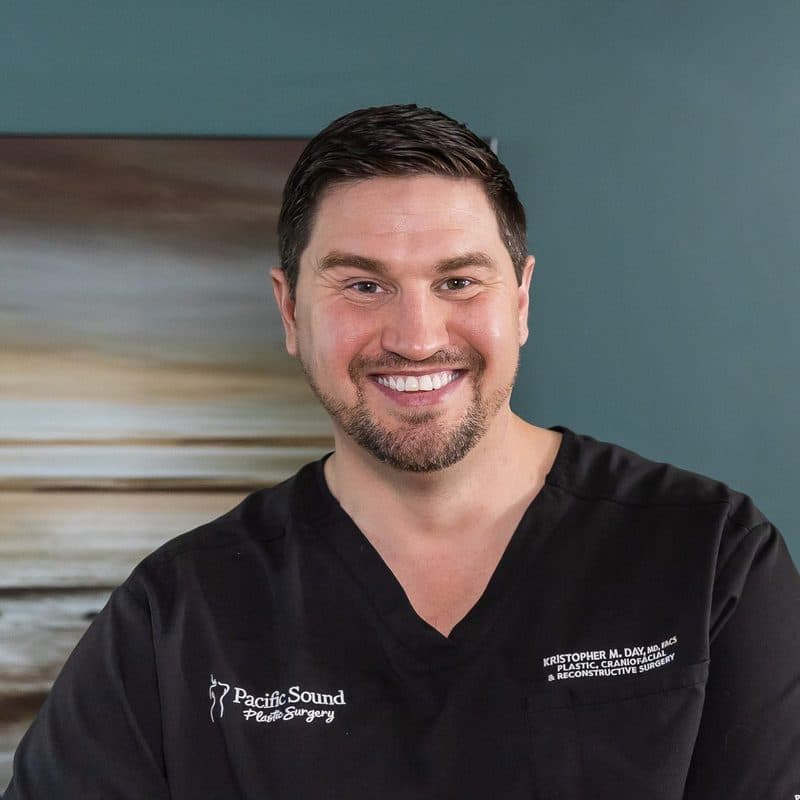
Dr. Kristopher Day is certified by the American Board of Plastic Surgery and the American Board of Surgery, fellowship-trained in craniofacial surgery, and a member of the American Society of Maxillofacial Surgeons.
Meet Dr. DayThe operation
Every consultation — and every operation — is with Dr. Day.
The implants are solid or semi-solid cohesive silicone, a different material class from breast implants. There is no gel or liquid inside, so leaking and deflation are not the failure modes these implants have; they are firm to the touch and designed to feel like developed muscle. The same material class is used in chin and calf implants.
Placement is beneath the pectoral muscle or under its fascia. The pocket is dissected precisely, the implant positioned, and the closure done so the implant sits where it was planned to sit rather than where gravity and movement would prefer.
The procedure runs one and a half to two and a half hours under general anesthesia at one of Dr. Day's accredited surgical facilities, and you go home the same day. A driver and a support person for the first forty-eight hours are required, not suggested.
Sizing is conservative by design. The result should read as a developed chest in proportion to the shoulders and arms, chosen against your frame rather than a catalog.
Where the incision goes
Three options, chosen for your anatomy, the implant size, and where you would rather carry a scar. This is decided with you at consultation, not on the day.
Axillary (armpit)
The most common choice: the scar sits in the armpit, off the chest entirely. It asks more of the dissection, since the pocket is developed at a distance from the opening.
Inframammary fold
The natural crease beneath the pectoralis. It gives the most direct access to the pocket, at the cost of a scar on the chest itself, low and in a shadow line.
Peri-areolar
At the lower border of the areola, where the colour change helps camouflage the line. Suited to particular anatomies and implant sizes rather than offered as a default.
Is it right for you
Two groups ask about this operation: men who train seriously and cannot build the chest volume genetics withheld, and men with congenital differences, including Poland syndrome, where one side of the chest developed incompletely. Candidates should be in good health and at a stable weight.
When the concern is fullness rather than absence, the conversation usually belongs to gynecomastia surgery instead. The exam sorts one from the other quickly.
The risks specific to this operation are worth naming rather than glossing: implant malposition, edges that become visible under thin coverage, capsular contracture, and asymmetry that would need revision surgery to correct. They are the reason the pocket dissection and the sizing matter as much as they do, and they are discussed with you before you decide, not afterward.
Because the operation is uncommon, patients sometimes shop it on price. The relevant question to ask any surgeon is not what it costs but what they do when an implant sits wrong — and you are entitled to ask that here.
Recovery
A compression garment supports the chest from day one. Follow-ups are unusually front-loaded for this operation: within 48 hours, then at one week, three weeks, six weeks, and three months. Dr. Day personally manages those visits, and anything between them goes to the practice team directly.
Desk work resumes within about a week. Expect the chest to feel tight and to sit higher than its final position early on — the pocket is still settling around the implant.
Chest training waits for clearance, typically around six weeks, so the pocket heals undisturbed. That restriction is the whole reason the result holds its position, and it is the one most often broken by exactly the patients who wanted this operation most.
How the weeks before and after surgery fit together is covered in the practice's recovery guide.
Plan a consultation with Dr. Day.
Patient Voices
Individual results vary. Quotes are verbatim excerpts from reviews published by patients.
“He takes the time to understand your aspirations, vision, and goals, ensuring that your desired outcomes are at the forefront of his care.”
“Dr. Day's knowledge, compassion, and attention to detail made all the difference in my recovery process.”
“He took the time to listen to my concerns and desires, ensuring I had a clear understanding of the procedure, expected outcome and healing process. … I think he's a very skilled and precise surgeon.”
Questions, answered
The rest belong in a conversation. Consultations are unhurried by design.
Can pectoral implants rupture?
Rupture and deflation are not how these implants fail, because there is nothing liquid inside them — they are solid or semi-solid cohesive silicone, unlike gel-filled breast implants. The material class is the same used in chin and calf implants. The complications that do occur are positional: malposition, visible edges, or capsular changes.
How much does pectoral augmentation cost?
Pectoral augmentation at Pacific Sound Plastic Surgery starts from $7,500, with the total shaped by operative time and your anatomy. Your consultation includes a written breakdown, with CareCredit and Alphaeon financing available.
Financing OptionsWhere will my scar be?
One of three places, decided with you: the armpit, the crease beneath the pectoralis, or the lower border of the areola. The armpit keeps the scar off the chest entirely and is the most common choice; the other two trade a chest scar for more direct access to the pocket.
How is this different from just training harder?
Training builds and tones the muscle you have. Its size and shape are largely set by genetics, which is why some men plateau on the chest specifically. The implant adds structure beneath the muscle — it is not a substitute for training and it does not do anything training would have done.
Is this the same as gynecomastia surgery?
It is the opposite problem. Gynecomastia surgery removes excess tissue from a chest with too much; pectoral augmentation adds structure to a chest with too little. The practice performs both, and the exam makes clear which conversation is yours.
How often is this operation performed?
Rarely, in this practice and in general: it is one of the least common procedures in plastic surgery, offered by a limited number of surgeons even in large cities. Dr. Day offers it, and discusses his experience with it plainly at consultation rather than around it.
When can I lift again?
Upper-body and chest training wait for clearance at around six weeks. Lower-body and light cardio return sooner. The six-week restriction protects the pocket while it heals around the implant, and it is not negotiable in the way patients frequently hope it is.
What about Poland syndrome?
Congenital chest-wall asymmetry, including Poland syndrome, is one of the operation's clearest indications, and the reconstructive judgment behind this practice is built for exactly this kind of planning. Sizing is done per side rather than as a matched pair.