Fat Transfer to the Breast in Bellevue
Fat transfer enhances the breast with your own tissue: liposuction harvests fat from where you have extra, and Dr. Day places it where you want volume. No implant, no foreign material — the result is made of you.
The technique suits patients who want a subtle, natural increase — typically about one cup size — and it pairs the enhancement with liposuction’s contouring of the donor area.
It is also a working tool across Dr. Day’s breast practice: refining results alongside implants, and rebuilding tissue quality in reconstruction.



Your surgeon
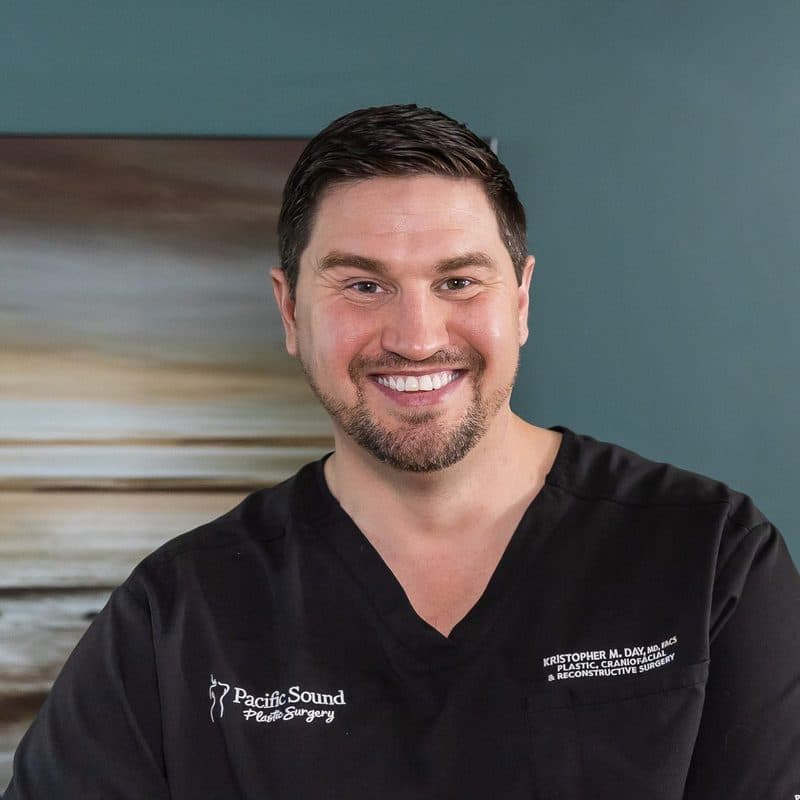
Dr. Kristopher Day is certified by the American Board of Plastic Surgery and the American Board of Surgery, fellowship-trained in craniofacial surgery, and a member of the American Society of Maxillofacial Surgeons.
Meet Dr. DayThe operation
Every consultation — and every operation — is with Dr. Day.
Fat is harvested by liposuction from the abdomen, flanks, or thighs with a gentle, low-pressure technique that preserves the fat cells. It is then purified and injected into the breast in small amounts across multiple tissue planes — placement discipline is what determines how much of the graft survives and how smooth the result reads.
A portion of transferred fat is naturally resorbed in the first weeks, so Dr. Day overfills slightly at surgery. A well-performed transfer typically retains 40–50% of the grafted volume long-term, and what survives behaves like the tissue around it.
Dr. Day follows current ASPS safety guidance for fat grafting, including the use of ultrasound guidance.
Three ways it is used
Fat transfer is a technique rather than a single operation, and it appears across the breast practice in three roles.
Standalone enhancement
A natural, implant-free increase of about one cup size, with contouring of the donor area built in.
Composite augmentation
Fat grafting layered with an implant to soften edges and refine shape — particularly valuable in revision work.
Reconstruction
Grafting rebuilds contour and improves tissue quality, including tissue affected by radiation.
Is it right for you
Good candidates want a modest, natural change, are at a stable weight in good health, and have enough donor fat for the volume they are after — many patients who consider themselves slim still do. Patients wanting a larger increase are usually better served by an implant, or by the combination.
Because the graft is living tissue, it follows your weight. Significant gain or loss after surgery changes the result proportionally, which is why a stable weight belongs in the plan.
Recovery
There are two recovery sites — the donor area and the breast. Most patients return to light activity within one to three days, and swelling and bruising at both sites typically settle over one to two weeks.
Early fullness includes the planned overfill; the shape softens as resorption completes. The final, settled result arrives at three to six months, and it is long-lasting at a stable weight.
How the weeks before and after surgery fit together is covered in the practice's recovery guide.
Plan a consultation with Dr. Day.
Patient Voices
Individual results vary. Quotes are verbatim excerpts from reviews published by patients.
“I have always gotten the realistic results I hope for.”
“Dr. Day was so compassionately patient and really took the time. … After the surgery, Dr. Day was just as dedicated and regularly checked up with me throughout my healing process.”
“Dr. Day and his team provided expert individualized care from the initial consultation through post-op check ups.”
Questions, answered
The rest belong in a conversation. Consultations are unhurried by design.
How much larger can fat transfer make my breasts?
Typically about one cup size. That ceiling is set by how much fat can be safely grafted and survive in one operation. Patients who want more than that are usually better served by an implant, or by fat grafting combined with one.
How is fat transfer different from implants?
The volume is your own living tissue rather than a device — it feels like you, needs no monitoring or exchange, and adds the donor-area contouring as part of the operation. The trade-off is scale: an implant can add substantially more volume than a graft.
How much of the fat survives?
A well-performed transfer typically retains 40–50% of the grafted volume long-term. Dr. Day accounts for the expected resorption by overfilling slightly at surgery, so the settled result reflects the natural process rather than fighting it.
Where does the fat come from?
Common donor areas are the abdomen, flanks, and thighs — chosen at consultation based on where you have fat to spare and where contouring would serve you. The harvest is standard liposuction with a gentle technique that keeps the fat cells viable.
Can fat transfer be combined with implants?
Yes — composite augmentation layers fat over an implant to soften its edges and refine the shape, and it is particularly useful in revision cases where thin tissue shows an implant’s outline.
What happens if my weight changes?
The transferred fat behaves exactly like your body’s own — because it is. It shrinks and expands with meaningful weight change, so the result is most durable at a stable weight.
Is fat transfer to the breast safe?
It is a well-established technique with a strong track record in board-certified hands, performed at an accredited facility. Dr. Day follows current ASPS safety guidance for fat grafting, including the use of ultrasound guidance.
How much does fat transfer to the breast cost in Bellevue?
Pricing is individualized — it depends on the donor areas, the volume transferred, and whether the grafting stands alone or joins another procedure. Your consultation includes a written quote, and financing is available through CareCredit and Alphaeon Credit.
Financing Options