Chemical Peels in Bellevue
A chemical peel is controlled exfoliation: an agent chosen for your skin lifts away damaged surface layers so fresher skin replaces them. The range runs from a lunchtime refresh to deep, physician-supervised correction.
Agent and depth are chosen against your Fitzpatrick skin type — the discipline that separates a good peel from a pigment problem, and the reason peels here live in a medical practice.
The peel arsenal is built on Obagi systems, paired with home regimens that prepare the skin before and protect the investment after.




Your surgeon
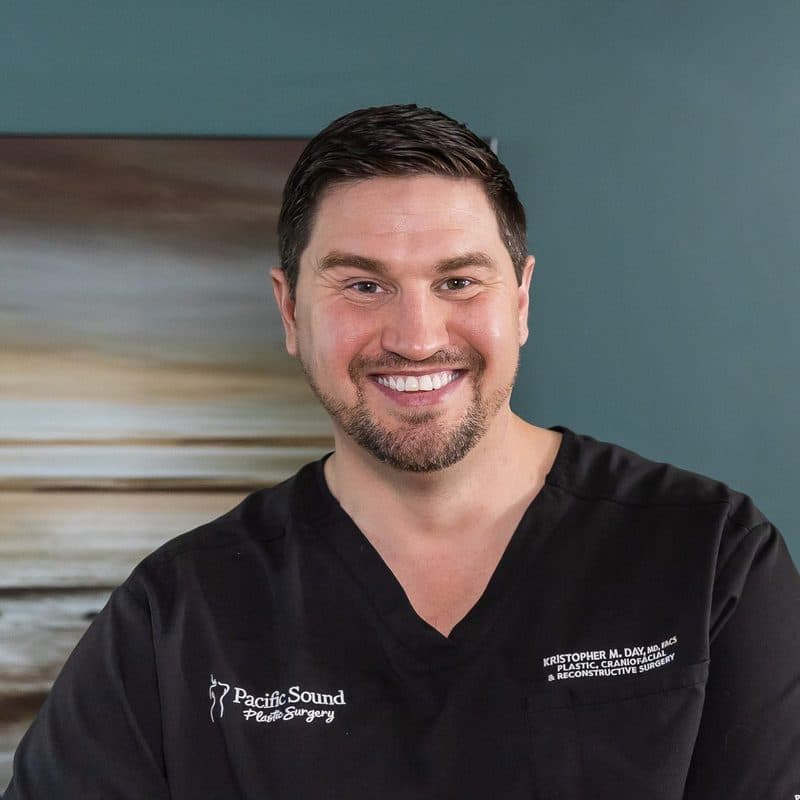
Dr. Kristopher Day is certified by the American Board of Plastic Surgery and the American Board of Surgery, fellowship-trained in craniofacial surgery, and a member of the American Society of Maxillofacial Surgeons.
Meet Dr. DayThe treatment
Non-surgical care in a plastic surgeon's practice.
Preparation starts weeks before the peel: a tretinoin-based regimen conditions the skin for two to four weeks, daily SPF 50 becomes routine, and waxing and other hair removal pause in the final week. Your current medications and supplements are reviewed for anything that interferes with skin healing. That groundwork is what lets the peel work evenly and heal predictably.
On the day, the skin is cleansed thoroughly and the agent is applied in controlled passes. The part that matters is not the application but the watching: skin responds at its own rate, and the solution is neutralized when your skin says so rather than when a timer does. Deeper peels are physician-supervised with sedation offered.
Appointments run thirty to sixty minutes by depth. Budget longer for a first visit, which includes the assessment that decides the depth in the first place.
Three depths
Depth follows the problem. Most plans run a series at one depth.
Superficial
Glycolic or lactic acid for glow, tone, and texture — a day or two of light flaking.
Medium
TCA for real correction of sun damage and pigment, with five to seven days of visible peeling.
Deep
Physician-supervised peeling for the most advanced damage, with sedation offered and seven to fourteen days of downtime.
Is it right for you
Good candidates have sun damage, uneven tone, texture, fine lines, hyperpigmentation or melasma, enlarged pores, or superficial acne scarring, with expectations matched to the depth chosen. Medium and deep peels sit most comfortably with Fitzpatrick types I through IV.
Darker skin is not excluded, but it is assessed rather than assumed. Fitzpatrick V and VI carry a real risk of post-inflammatory hyperpigmentation with certain acids at aggressive depths, and some agents — lactic acid among them — are gentler across a wider range of tones. Conservative depth selection is the safeguard, and it is applied deliberately rather than apologetically.
Not yet: Accutane within the past six to twelve months, an active cold sore or open lesion, a keloid history for medium and deep peels, recent radiation to the area, or pregnancy and breastfeeding. The skin assessment sorts timing candidly, and one honest disqualifier is expectation itself — a single peel does not correct what years of sun built.
What to expect
Superficial peels flake lightly for a day or two; medium peels shed visibly for five to seven days and the skin often darkens before it sheds, which alarms people who were not warned; deep peels crust and re-epithelialize over one to two weeks with full healing taking several more. Peeling skin is never picked — it lifts on its own schedule.
The aftercare is short and it is not optional. Stay out of direct sun for several weeks, use only the cleanser and moisturizer you are sent home with, and leave retinol and acid exfoliants alone until you are cleared to restart them. How closely you follow that week determines how well the peel heals.
Sunscreen discipline afterward is what locks in the result. Most correction plans run a series of three to six peels, four to six weeks apart; a medium peel is often maintained with one or two a year instead.
Patient Voices
Individual results vary. Quotes are verbatim excerpts from reviews published by patients.
“I have always gotten the realistic results I hope for.”
“Dr. Day was so compassionately patient and really took the time. … After the surgery, Dr. Day was just as dedicated and regularly checked up with me throughout my healing process.”
“Dr. Day and his team provided expert individualized care from the initial consultation through post-op check ups.”
Questions, answered
The rest belong in a conversation. Consultations are unhurried by design.
Which depth do I need?
The mildest depth that solves your actual problem: glow and tone from superficial passes, pigment and sun damage from medium TCA work, advanced damage from supervised deep peeling. The assessment gives you a specific answer, and starting conservative is house policy.
Are peels safe for darker skin?
Yes, with the right agent and depth — that is precisely the Fitzpatrick-matching discipline. Conservative depth selection protects against post-inflammatory pigmentation, and a candid assessment comes before any peel.
Why is there a prep phase?
Tretinoin conditioning for two to four weeks thins the damaged surface evenly, so the peel penetrates uniformly and heals faster. Skipping prep is how peels go blotchy.
How much peeling should I expect?
It scales with depth — light flaking for superficial peels, a week of visible shedding for medium, up to two weeks for deep. The calendar around events is planned with you honestly.
Chemical peel or microneedling?
Peels resurface from above and excel at pigment and sun damage; microneedling rebuilds from below and excels at texture and scarring. Many plans alternate the two, four weeks apart.
Can I have a peel around facial surgery?
Yes, and sequencing it deliberately is one of the advantages of having both under one roof. A peel before an operation can put the skin in better condition going in, and a post-surgical protocol supports the result once healing allows it. The timing depends entirely on the procedure and where you are in recovery, so it is planned rather than improvised.
Can I have a peel and injectables in the same week?
Usually they are booked on separate days. A healing skin surface and fresh filler or Botox each want their own conditions, and separating them costs you a second appointment rather than a result. If you are pursuing several treatments, the order is mapped out at the assessment.
Which Obagi products does the practice carry?
The Obagi line, including Nu-Derm, prescription tretinoin, the Blue Peel Radiance kit, and SPF 50 Sunshield Matte. The in-office peel and the home regimen are designed as one program — the products prepare the skin beforehand and protect the result afterward.
How much does a chemical peel cost?
From $250 for a superficial peel to $2,950 for the deepest supervised treatments, with series pricing quoted at your skin assessment.