Calf Augmentation in Bellevue
Calf augmentation places solid silicone implants along the calf to bring the lower leg into proportion, whether the gap is genetic, the residue of injury or illness, or a muscle group that resists training that built everything else.
The muscle in question is the gastrocnemius — the two-headed muscle that gives the calf its visible shape. Unlike body fat, which responds to what you eat and how you train, the size and attachment of that muscle are largely set by genetics. That is the whole reason a lower leg can stay stubbornly out of proportion with a body that responded to everything else.
It is among the least common operations in plastic surgery, and the practice offers it with that fact on the table. When it is the right operation, it is planned with the same rigor as any other.




Your surgeon
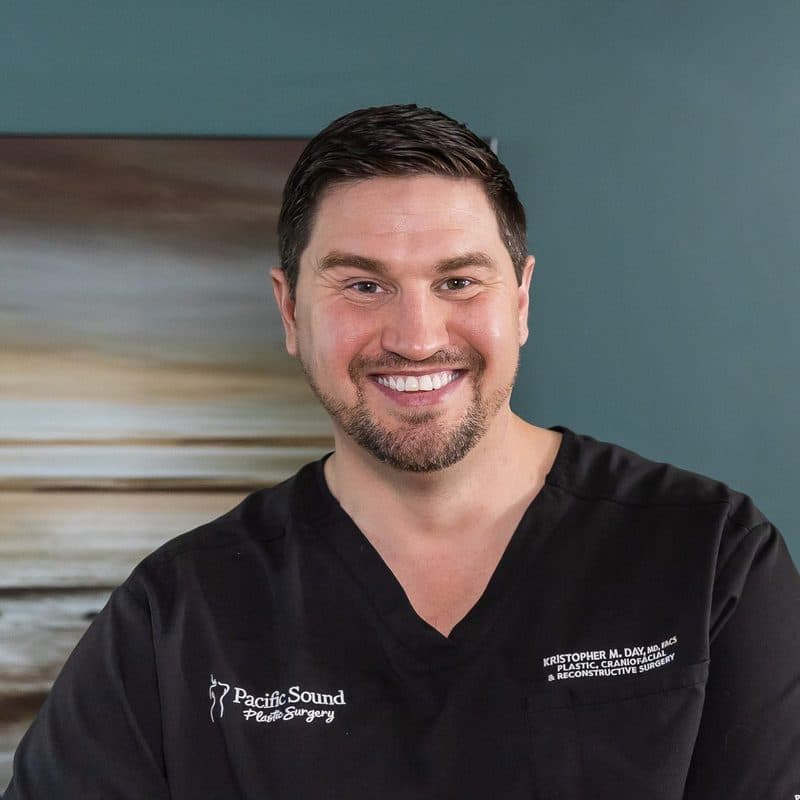
Dr. Kristopher Day is certified by the American Board of Plastic Surgery and the American Board of Surgery, fellowship-trained in craniofacial surgery, and a member of the American Society of Maxillofacial Surgeons.
Meet Dr. DayThe operation
Every consultation — and every operation — is with Dr. Day.
A solid cohesive silicone implant is placed through a short incision hidden in the natural crease behind the knee, into a pocket created in the subfascial plane — directly beneath the fascia covering the gastrocnemius. That plane is the point of the technique: it keeps the implant from migrating and lets it move with the muscle instead of sitting on top of it.
One implant shapes the inner calf; two balance inner and outer when the goal calls for it. Both legs are treated in the same session so the result is symmetric by design rather than by a second operation.
Because the implants are solid, leaking and deflation are not how they fail. The complications that do occur — malposition, or changes in the capsule the body forms around any implant — are uncommon, and they are reviewed with you at consultation rather than discovered afterward.
The procedure runs roughly one to two hours under general anesthesia as an outpatient case at one of Dr. Day's accredited facilities. You recover briefly at the facility and go home the same day with a trusted adult.
One implant or two
The plan is built per leg. What you need depends on where the leg falls short, not on a standard package.
Medial only
A single implant along the inner calf — the most common plan, since the inner head of the muscle is where the shortfall usually reads.
Medial and lateral
Two implants per leg, balancing inner and outer, when the goal is fuller circumference rather than inner-calf shape alone. It is also the larger driver of cost.
Asymmetry correction
Sizing done independently for each leg where one calf is smaller — after injury, clubfoot, polio, or other conditions that left the sides unequal. Sometimes only one leg is implanted at all.
Combined lower-leg contouring
Augmentation paired with liposuction of the lower leg or ankle, where the proportion problem is partly fullness at the ankle rather than volume at the calf.
Is it right for you
The patient population here is more varied than the men's category suggests. It includes men and women seeking proportion between upper and lower leg; athletes and competitors for whom calf development is genetically capped; patients with muscle atrophy after injury, illness, or neurological conditions such as spina bifida or polio; and transgender and non-binary patients seeking a more proportionate lower leg as part of gender-affirming body contouring.
The operation is not exclusive to men. It sits in the men's line because men ask for it most, and the consultation is the same honest conversation either way.
Candidates should be in good general health with a stable body weight, and should be clear that this is a structural change rather than a training aid. The implant adds volume in a fixed amount and a fixed place; it does not make the muscle stronger and it will not develop further.
Your first appointment is an in-person evaluation. Dr. Day does not perform virtual consultations for surgery — implant size and pocket placement are decided from your actual lower-leg anatomy, skin quality, and existing muscle volume, and 3D imaging may be used to help you see what a given size would look like on your leg.
Recovery
This is the recovery patients underestimate. Crutches or a walker are typically recommended for the first few days, because your calves are what you stand on and they have just had implants placed beneath their fascia. Most patients are walking the day after surgery, awkwardly at first, and normalize over the following weeks. Keep the legs elevated when resting during week one.
A compression garment is worn 23 hours a day through the early healing period. Desk work usually resumes within the first week.
Exertional activity restarts in weeks two to four at roughly half your previous maximum, building progressively, with a full return including running and high-impact training typically cleared at weeks four to six. Follow-ups run at one week, three weeks, six weeks, and three months.
Initial results are clear within the first four to six weeks. The settled result appears at three to six months, once swelling has fully resolved.
How the weeks before and after surgery fit together is covered in the practice's recovery guide.
Plan a consultation with Dr. Day.
Patient Voices
Individual results vary. Quotes are verbatim excerpts from reviews published by patients.
“He takes the time to understand your aspirations, vision, and goals, ensuring that your desired outcomes are at the forefront of his care.”
“Dr. Day's knowledge, compassion, and attention to detail made all the difference in my recovery process.”
“He took the time to listen to my concerns and desires, ensuring I had a clear understanding of the procedure, expected outcome and healing process. … I think he's a very skilled and precise surgeon.”
Questions, answered
The rest belong in a conversation. Consultations are unhurried by design.
How much does calf augmentation cost?
Calf augmentation at Pacific Sound Plastic Surgery starts from $7,000, with the total shaped by implant selection and whether one or two implants per leg are planned. Your consultation includes a written breakdown, with CareCredit and Alphaeon financing available.
Financing OptionsCan calf implants rupture?
Leaking and deflation are not how solid silicone implants fail — there is nothing liquid inside them, the same material class as chin and pectoral implants. The complications that do occur are positional or capsular, they are uncommon, and Dr. Day reviews them with you before you decide.
How soon will I be walking normally?
Most patients walk the day after surgery, and crutches or a walker are typically recommended for the first few days while the legs are tight and sore. Normal walking returns over the following weeks; running and impact training wait for clearance at around four to six weeks.
Will the implants look natural?
The implant sits beneath the calf fascia, so it follows the muscle's own line and moves with it rather than sitting on top of it. Sizing against your leg, not a catalog, does the rest — the goal is proportion, not obvious augmentation.
Can it fix uneven calves?
Yes, and asymmetry is one of the clearer indications. Each leg is sized independently, and in some cases only one leg is implanted. Asymmetry after injury, clubfoot, polio, or similar conditions is planned the same way.
Is calf augmentation only for men?
No. Women pursue it for the same aesthetic and reconstructive reasons, and it is also sought by transgender and non-binary patients as part of gender-affirming body contouring. The operation and the planning are identical.
Where is the scar?
In the natural crease behind the knee, a few centimetres long, where the skin folds conceal it. It fades over roughly the first year and is not visible in normal standing or walking.
Do the implants need replacing?
Not under ordinary circumstances. Solid silicone holds its shape and does not deflate the way fluid-filled designs can. Apparent calf size can shift modestly with significant weight change, but that is the leg around the implant changing rather than the implant itself.