Microneedling in Bellevue
Microneedling puts your skin's own repair machinery to work: micro-channels created in the skin trigger a collagen-building response that smooths texture, softens fine lines, and remodels scarring over a treatment series.
In this practice it carries a distinctly surgical application as well — remodeling surgical scars from six months after an operation, which makes it a natural companion to the practice's core work.
Treatments run under physician direction, with depth and protocol set to your skin.




Your surgeon
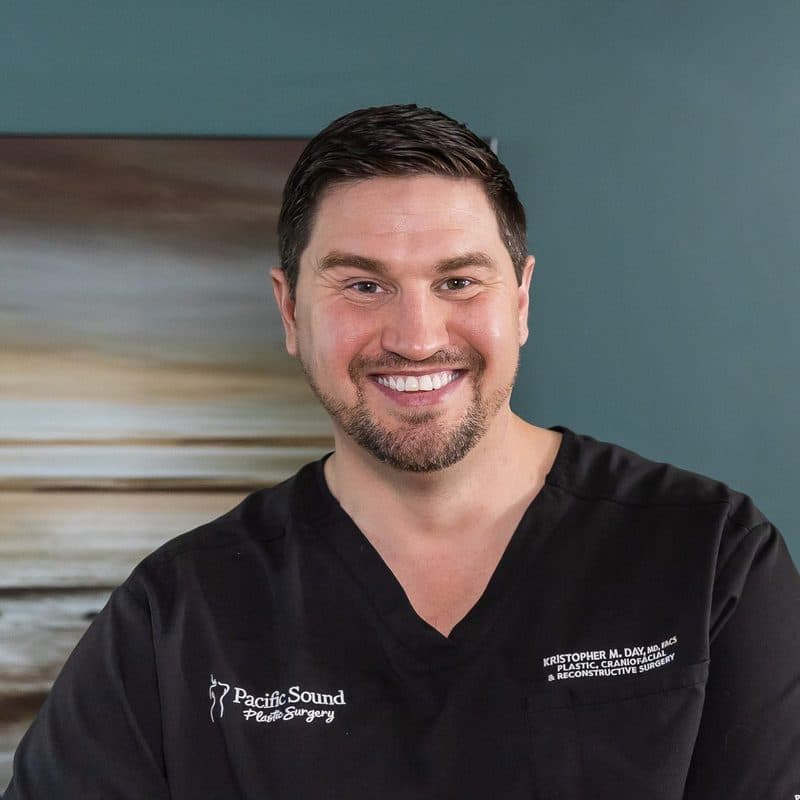
Dr. Kristopher Day is certified by the American Board of Plastic Surgery and the American Board of Surgery, fellowship-trained in craniofacial surgery, and a member of the American Society of Maxillofacial Surgeons.
Meet Dr. DayThe treatment
Non-surgical care in a plastic surgeon's practice.
Topical numbing goes on thirty to forty-five minutes ahead, and the skin is cleansed and prepped while it takes effect.
A precision device then creates controlled micro-channels at depths adjusted zone by zone — shallower over thin skin, deeper where scarring or texture demands it. The face alone takes thirty to sixty minutes. A growth-factor serum follows while the channels are open, and sun protection goes on before you leave.
The mechanism is your own repair response, borrowed deliberately. Thousands of controlled micro-injuries start the wound-healing cascade, and that cascade lays down new collagen and elastin. Nothing is removed and nothing is added, which is why microneedling asks for a series rather than a single dramatic session.
The face is the usual canvas, with the neck, décolletage, and body treated where texture or scarring calls for it.
What a series is aimed at
Same device, different depths and different timelines. The goal decides both.
Texture and fine lines
The broadest use, and the one that suits the widest age range — early texture concerns through to crepiness and settled lines.
Acne scarring
Rolling and boxcar scarring responds to deeper passes over more sessions. Expect the longer end of the series.
Surgical scars
From about six months after an operation, once the wound is fully healed: remodels scar collagen and softens the pigment that can track along an incision line.
Pores and tone
Enlarged pores and uneven tone improve as the surrounding collagen thickens and the surface evens out.
Is it right for you
Microneedling serves texture, acne scarring, fine lines, enlarged pores, and uneven tone. Because the injury is mechanical rather than thermal or chemical, it is generally workable across skin types, which is a meaningful advantage where a laser or a deep peel would carry pigment risk. Surgical scars become candidates for remodeling from about six months after surgery.
Set the expectation correctly and you will be happy with it: this is gradual, cumulative change in the quality of your skin. It is not a lift and it does not replace volume. A single session is not a result, and anyone who tells you otherwise is selling something.
Active acne and Accutane use within the past six months defer treatment, and the skin assessment sorts timing honestly.
What to expect
Expect redness like a brisk sunburn for a day or two, with makeup typically fine after twenty-four hours. Diligent sunscreen is non-negotiable while the skin rebuilds.
Collagen remodeling compounds over the series — three to six sessions spaced about four weeks apart — with the skin's quality improving for months after the last one. Once the series is finished, an annual session or two holds the ground it gained.
Patient Voices
Individual results vary. Quotes are verbatim excerpts from reviews published by patients.
“Dr. Day and his team provided expert individualized care from the initial consultation through post-op check ups.”
“He takes the time to understand your aspirations, vision, and goals, ensuring that your desired outcomes are at the forefront of his care.”
“Dr. Day's knowledge, compassion, and attention to detail made all the difference in my recovery process.”
Questions, answered
The rest belong in a conversation. Consultations are unhurried by design.
What does microneedling actually improve?
Texture, fine lines, acne scarring, pore appearance, and tone — the surface-quality problems that creams plateau on. It rebuilds collagen rather than covering its absence.
How many sessions do I need?
Three to six, spaced about four weeks apart, calibrated to your skin and goal. Scar remodeling tends toward the longer end; maintenance visits then hold the gains.
Can it improve my surgical scar?
Yes — from about six months post-op, microneedling remodels scar collagen and blends texture with the surrounding skin. In a surgical practice, it is a natural part of finishing the result.
Microneedling or a chemical peel?
Needles rebuild from below; peels resurface from above. Texture and scarring favor microneedling, pigment and sun damage favor peels, and many plans alternate the two. The skin assessment decides.
Does it hurt?
With thirty to forty-five minutes of topical numbing first, most patients describe vibration and pressure rather than pain.
Can I add PRP to it?
Yes, and it is the pairing known as the vampire facial. Platelet concentrate prepared from your own blood is delivered through the channels while they are open. It is discussed at the assessment as an option rather than assumed.
Is it suitable for deeper skin tones?
Generally yes, and that is one of its real advantages. Microneedling injures the skin mechanically rather than with heat or acid, so it sidesteps much of the pigment risk that makes laser resurfacing and deep peels a careful conversation on darker skin. The assessment still comes first.
How much does microneedling cost?
A three-treatment series starts from $899, with per-session and package pricing quoted at your skin assessment before anything begins.